Cat Sleeping Positions and Meaning: What Each Position Usually Tells You
Cat sleeping positions can tell you a lot about how comfortable, warm, and relaxed your cat feels at that moment, even though no single position is a diagnosis of anything. A cat that curls into a tight ball is usually saving warmth, a cat stretched out on its side is usually feeling safe enough to relax fully, and a cat sitting in the loaf shape is often resting lightly rather than sleeping deeply. Once you learn the common shapes, you can read your cat’s rest more calmly and notice changes in pattern over time, instead of worrying about one nap in isolation.
This guide explains the most common positions in plain language, what each one usually means, and what it does not mean. Positions are described here as comfort and general meaning only, never as diagnoses. A position alone cannot tell you that a cat is ill, in pain, or happy in any medical sense, and it should never replace observation of eating, drinking, play, litter box habits, and general behaviour over days. If you are ever unsure about a change in your cat, a veterinarian is the right person to ask.
For the wider picture on how much cats sleep and why long naps are normal, the Why cats sleep so much pillar article explains total sleep, age differences, and daily rhythm in detail, while this article focuses only on the shapes cats sleep in. You can also browse more behaviour guides in the Cat Behaviour and Care category if you want to build up your understanding of everyday cat behaviour step by step.
Cat Sleeping Positions and What They Usually Mean
Cat sleeping positions usually reflect three simple things: warmth, safety, and how deeply the cat plans to sleep. A cat that feels cold will often tuck its paws and tail in close to keep body heat in. A cat that feels safe in its home may stretch out, expose its belly, or sleep with its paws loose and relaxed. A cat that is only resting lightly will often keep its head up, its ears moving, or its paws tucked under its body so it can get up quickly.
Context matters as much as shape. The same curled position can mean warmth on a cold evening, comfort in a favourite bed, or a wish for privacy after a busy day. The same stretched position can mean deep relaxation in a quiet room, or simply that the cat found a warm patch of sun and does not want to move. Look at the whole scene: the room, the temperature, the time of day, and whether the cat has just played, eaten, or groomed. That context will usually explain the position better than the shape alone.
It also helps to remember that cats sleep in both light and deep stages. During light sleep, a cat may rest with ears twitching and eyes partly open, and it can wake quickly at a sound. During deeper sleep, the body is looser, the paws may twitch, and the cat may be slower to wake. A cat in the loaf shape is often in lighter rest, while a cat stretched on its side or back is often in deeper sleep. Neither stage is better on its own, and both are normal parts of a cat’s day.
A Simple Cat Sleeping Positions Table You Can Use at a Glance
This table gives a quick summary you can come back to. Read it as a general guide to comfort and meaning, not as a checklist for health. If a position is new for your cat but everything else looks normal, it is usually just a new favourite way to rest.
| Position | What it usually looks like | What it usually means |
|---|---|---|
| Curled ball | Nose near tail, paws tucked in, tail wrapped around the body | Saving warmth and feeling settled, often in a cooler room or a snug bed |
| Loaf | Paws tucked under the body, head up, tail wrapped around the side | Light rest, alert and ready to get up, not yet in deep sleep |
| On the side | Body stretched out on one side, legs extended or slightly bent | Relaxed and comfortable, often in deeper sleep in a safe spot |
| On the back | Belly exposed, paws up or out to the sides | Feeling very safe and warm, but not an invitation to touch the belly |
| Paws over the face | Lying down with one or both paws covering the eyes or nose | Blocking light, settling in for sleep, or keeping the face warm |
| Head on paws | Lying flat with the head resting on the front paws | Calm rest, often after play or a meal, easy to wake from |
| Against you or another pet | Pressed against a person, a pet, or a warm object | Seeking warmth and closeness, feeling secure in that spot |
| Hidden away | Sleeping inside a box, under a bed, or behind furniture | Wanting quiet and privacy, especially in a busy home |
| Half in, half out | Body partly in a bed or box, with the head or back legs outside | Comfortable but not fully settled, or cooling down after warmth |
The Curled Ball: Warmth and a Sense of Security
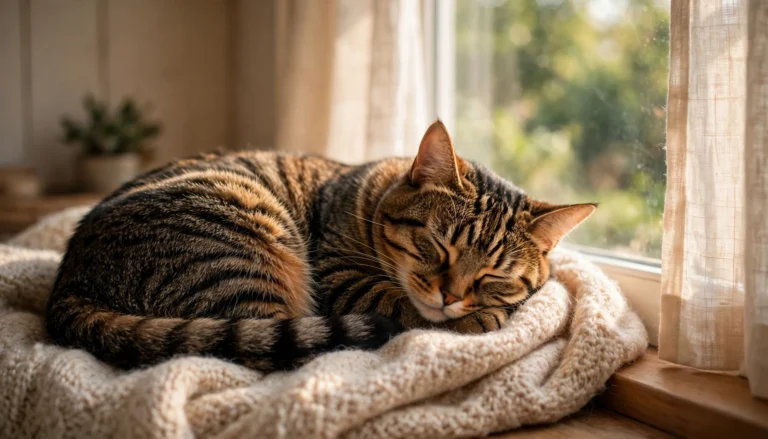
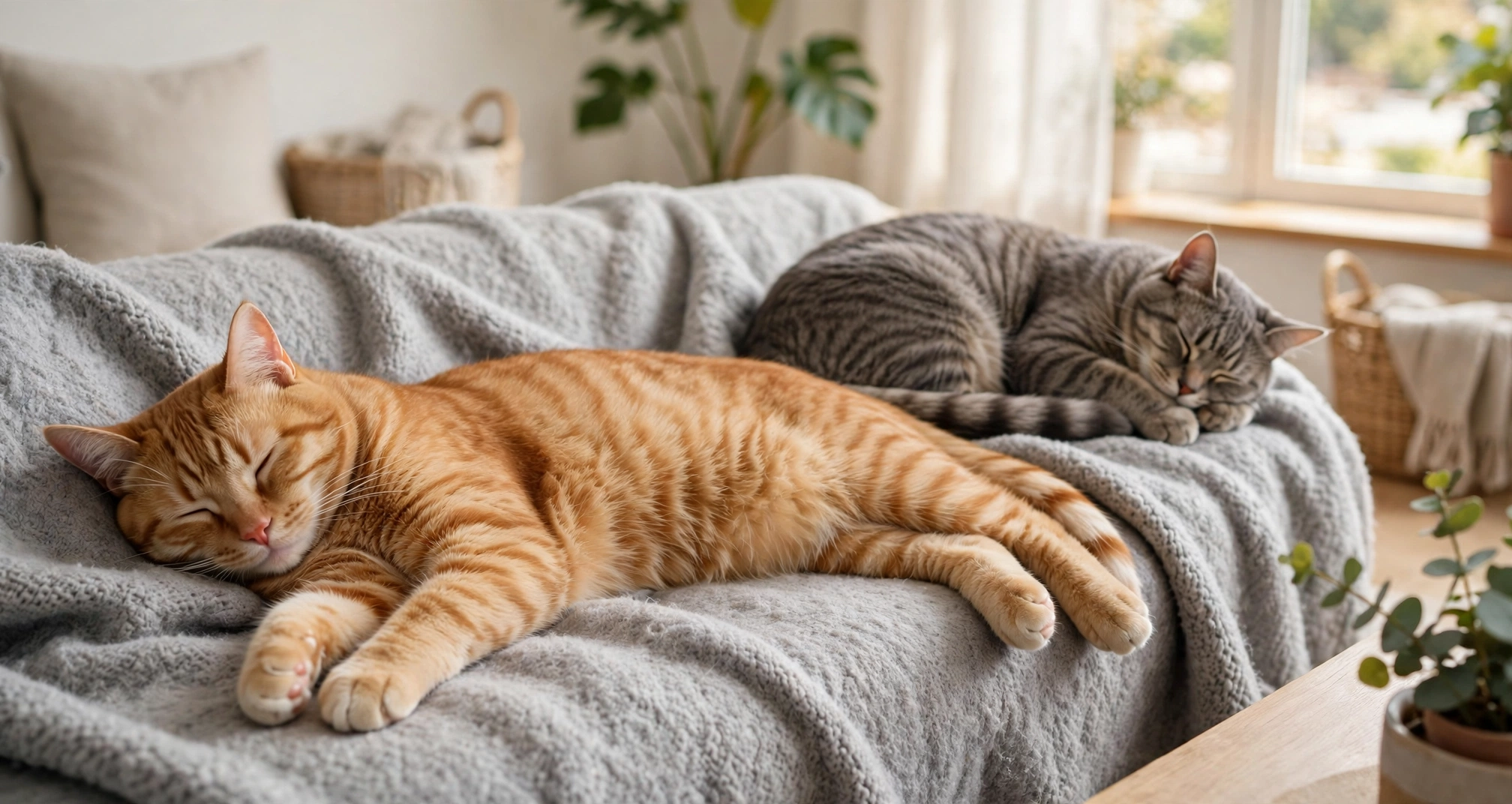
The curled ball is one of the most familiar cat sleeping positions, and it is easy to recognise. The cat tucks its paws close, wraps its tail around its body, and often rests its nose near its tail. This shape helps the cat keep warmth in, because less of the body is exposed to cool air. Cats often choose this shape in cooler rooms, near a draught, or in a bed that feels snug around them.
A curled cat is not necessarily cold in a worrying sense. Many cats simply prefer a compact shape, even in a warm home, because it feels settled and protected. Kittens often sleep curled against littermates or a warm blanket, and adult cats may keep the same habit in a favourite chair or bed. If your cat curls up in the same spot every evening, that is usually a routine, not a signal of a problem.
You can support this preference with a bed that has raised sides, a soft blanket, and a spot away from draughts. Avoid moving the bed just because the shape looks uncomfortable to you. Cats choose shapes that work for their bodies, and a tight curl that looks cramped to a person can feel perfectly comfortable to a cat. The useful thing to notice is change: if a cat that always stretches out suddenly curls tightly for days and also stops eating or playing, that pattern change is worth noting and discussing with a vet.
The Loaf: Light Rest, Not Deep Sleep
The loaf is the position where a cat sits with its paws tucked neatly underneath its body, its head up, and its tail wrapped around its side. From the front, the cat looks like a loaf of bread, which is where the name comes from. This is usually light rest rather than deep sleep. The cat is settled, but it is still fairly alert and can stand up quickly if something interesting happens.
Cats often loaf after a meal, while watching a room, or when they want to rest without fully switching off. A loafing cat may blink slowly, watch you, or listen to sounds in the house with its ears moving. This is a normal middle state between being fully awake and being deeply asleep. It is not a sign that the cat cannot sleep, and it is not a sign that the cat is unhappy.
If your cat loafs a lot in a busy part of the house, it may simply like being near people while still resting. If you want to encourage deeper sleep, offer a quieter spot as well, such as a bed in a calm room, and let the cat choose. Cats move between loafing and deeper sleep through the day, and that movement is normal. Try not to disturb a loafing cat for a cuddle unless it invites contact, because a light rest can be broken easily and the cat may simply move away.
On the Side: Relaxed and Deeply Asleep
Sleeping stretched out on the side, with legs extended or slightly bent, is one of the clearest signs of relaxation in cat sleeping positions. The cat has let its muscles loosen, its breathing is usually slow and even, and it may stay in this shape for a long stretch. Cats often choose this position in a warm room, in a sunny spot, or in a place where they feel safe from sudden disturbance.
This is also the position where you may see twitching paws, flicking ears, or small movements of the whiskers during deeper sleep. Those small movements are common during dream-like sleep stages and are not, on their own, a cause for concern. The cat may be slower to wake from this position than from a loaf, because it has settled more fully into sleep. Let it wake in its own time when you can, rather than picking it up suddenly.
A cat that sleeps on its side in the middle of a room is showing trust in that space, because its belly and side are more exposed than in a curled shape. That trust is built over time through calm handling, regular feeding, and a home that feels predictable. If a shy or new cat does not sleep on its side yet, that is not a failure. Many cats take weeks to relax fully in a new home, and they may start with hidden or curled sleep before they stretch out.
On the Back: Safe, Warm, and Not Always an Invitation
Sleeping on the back, with the belly exposed and paws up or out to the sides, often surprises new cat owners. It looks vulnerable, and in a sense it is, because the belly is the softest part of the body. A cat that sleeps this way in your home is usually feeling very safe and warm, and it has no need to protect its belly at that moment. This is one of the reasons this position is so loved by cat owners: it looks completely relaxed.
It is important not to read this position as an invitation to rub the belly. Many cats that happily expose their belly in sleep will still dislike belly touch when awake, and some will react quickly if touched there. The exposed belly in sleep is about comfort and temperature, not about asking for contact. Enjoy watching it, but let the cat decide about touch when it wakes up.
Cats often sleep on their backs in warm weather or in a warm spot, because exposing the belly helps them cool down slightly. If your cat only does this in summer or near a sunny window, temperature is a likely part of the explanation. Provide a cool, shaded alternative nearby as well, so the cat can move if it gets too warm. As with every position, the meaning is general comfort, not a medical message.
Paws Over the Face and Head on Paws
Paws over the face is a charming position, and it usually has a simple explanation: the cat is blocking light. Cats often cover their eyes with a paw when sleeping in a bright room or near a window, in the same way a person might pull a blanket over their face. It can also help keep the face warm, or it can simply be a comfortable way to settle the head. A cat in this position is usually settling in for sleep, not hiding from something.
Head on paws is a calmer, flatter rest. The cat lies down with its head resting on its front paws, its body stretched or slightly curled, and its eyes closed or half closed. This is common after play, after a meal, or during a quiet afternoon. The cat is resting, but it can wake easily if called or if food is prepared nearby. Both positions are normal, and both can appear in the same cat on different days.
If your cat often covers its face in a bright room, a simple practical step is to offer a bed in a dimmer corner as well as the sunny spot. The cat can then choose light or shade. Do not cover the cat with a blanket to help it, because most cats dislike being covered and will move away. Choice of spot matters more than any accessory, and a cat that can move freely between spots will usually find its own comfortable balance.
Sleeping Against You, Against Another Pet, or Hidden Away
Some cats sleep pressed against a person, another pet, or a warm object such as a cushion or a hot water bottle that has cooled to a safe temperature. This position is usually about warmth and closeness. Cats that sleep against you often feel secure in your presence, and they may return to the same spot every night. That routine can be a lovely part of living with a cat, as long as you can still sleep comfortably yourself.
Other cats prefer to sleep hidden away, inside a box, under a bed, or behind furniture. This is also normal, especially in a busy home, a new home, or a home with visitors, children, or other pets. A hidden spot gives the cat quiet and control: it can rest without being watched or disturbed. A cat that hides all the time and stops eating, drinking, or using the litter box is a different matter, and that pattern change should be discussed with a vet, but hiding to sleep alone is not a problem.
The practical step here is to offer both kinds of spot: a social spot near people, and a private spot where the cat will not be disturbed. A cardboard box with a soft blanket inside, placed in a quiet corner, is often more popular than an expensive bed, because it feels enclosed and safe. Let the cat choose, and try not to pull it out of a hiding spot for attention. Trust grows when a cat learns that its resting places are respected.
How to Read Cat Sleeping Positions Without Overthinking Them
The simplest way to read cat sleeping positions is to look for patterns over days, not single naps. Note where your cat sleeps, which shapes it uses most, and whether it eats, drinks, plays, and grooms as usual. A cat with a steady routine, a good appetite, regular litter box use, and short bursts of play is usually doing well, whatever shape it sleeps in. A single unusual nap, on its own, rarely means anything important.
A change worth noting is a sudden, lasting change combined with other changes. For example, a cat that always slept stretched out but now hides away for most of the day, eats much less, and stops playing is showing a pattern change, not just a new sleeping position. In that case, note what changed and when, and ask a veterinarian for advice. This guide is general information only, not veterinary advice, diagnosis, or treatment, and the vet disclaimer on the About page states the same point for all guides on this site: guides are general information only, not veterinary advice, diagnosis, or treatment, and you should consult a veterinarian about your own cat.
For general background on feline behaviour, Cornell University College of Veterinary Medicine publishes reliable general information about cats and their behaviour, and it is a useful place to check broad topics before you draw conclusions from one position. Use it as background reading, not as a substitute for advice about an individual cat. Your own vet knows your cat’s age, history, and health, and that individual knowledge matters far more than any general guide.
Practical Steps for Comfortable Cat Sleep
You do not need special equipment to support good cat sleep, but a few simple choices help most cats. First, offer more than one sleeping spot, in different temperatures and levels of privacy, so the cat can choose warmth, sun, shade, or quiet as it wishes. Second, keep sleeping spots in calm places, away from loud appliances, busy doorways, and litter boxes, because cats rest better where they feel undisturbed.
Third, match play to your cat’s active times, often early morning and evening, with short play sessions rather than one long session. A cat that has played, eaten, and groomed will often settle more easily afterwards. Fourth, keep feeding and daily routines fairly regular, because cats feel secure when the day is predictable. Fifth, wash bedding regularly, but keep a familiar blanket or item with the cat’s scent, because a completely new-smelling bed can feel strange at first.
Finally, respect sleep. Avoid waking a deeply sleeping cat for photos or cuddles, and teach children to let a sleeping cat rest. A cat that learns its sleep is respected is more likely to sleep openly in shared rooms, which in turn makes its positions easier to read. Comfort, choice, and calm routine are the real foundations here, and they matter more than the exact shape of any one nap.
What do cat sleeping positions mean?
Cat sleeping positions usually show comfort, warmth, and how deeply a cat is resting. A curled shape often means saving warmth, a stretched side position often means deep relaxation in a safe spot, and a loaf usually means light rest. No single position is a diagnosis, so read the shape together with eating, play, and general behaviour over days.
Why does my cat sleep curled up in a ball?
Cats often sleep curled up to keep warmth in and to feel settled in a snug spot. The tucked paws and wrapped tail reduce heat loss, and many cats simply prefer this compact shape even in a warm home. It is a common and normal way to sleep.
What does it mean when a cat sleeps in the loaf position?
The loaf, with paws tucked under the body and head up, usually means light rest rather than deep sleep. The cat is settled but still fairly alert and can get up quickly. Cats often loaf after a meal, while watching a room, or when they want to rest near people without fully switching off.
Is it normal for a cat to sleep on its back?
Yes, sleeping on the back is normal for many cats and usually means the cat feels very safe and warm in that spot. The exposed belly is about comfort and temperature, not an invitation to touch the belly, because many cats still dislike belly touch when awake.
Why does my cat sleep on its side with its legs stretched out?
Sleeping on the side with legs stretched out usually means the cat is relaxed and in deeper sleep in a place it trusts. Muscles loosen in this position, breathing is usually slow and even, and small paw twitches during sleep are common. Let the cat wake in its own time when possible.
Why does my cat change sleeping positions during the day?
Cats change sleeping positions because temperature, light, noise, and energy levels change through the day. A cat may curl up in a cool room, stretch out in the sun, loaf near people, and hide away for quiet rest, all in one day. That variety is normal and shows the cat is choosing comfort for each moment.
Should I worry if my cat suddenly changes how it sleeps?
A single new position is usually not a worry, but a sudden lasting change combined with other changes, such as eating much less, hiding all day, or stopping play, is worth noting and discussing with a veterinarian. This guide is general information only, not veterinary advice, diagnosis, or treatment.