Best Cat Food for Indoor Cats: Dry, Wet, and How to Choose
Best cat food for indoor cats is a complete and balanced food that fits your cat’s age, body weight, activity level, and health needs, served in measured portions and changed slowly when a change is needed. There is no single food that suits every indoor cat, because indoor cats still differ in size, age, appetite, and how much they move during the day.
The goal is steady weight, good energy, normal digestion, and a coat and stool pattern that stays stable over time.
Indoor cats usually move less than cats that roam outside, so they can gain weight more easily if portions are generous and treats add up without anyone noticing. That does not mean every indoor cat needs a low calorie food, and it does not mean a food labelled for indoor cats is automatically right.
It means portion control, play, and regular weight checks matter as much as the bag or can you buy. A simple routine often works better than frequent food changes.
This guide explains the main food types in plain terms, what indoor cats need most, how to read a label without getting lost in marketing words, and how to switch foods safely. It does not rank commercial brands, and it does not replace advice for a cat with a health problem.
As explained on the About page, these guides are general information only, not veterinary advice, diagnosis, or treatment, and you should consult a veterinarian for health problems or feeding questions linked to illness.
Best cat food for indoor cats: what indoor cats need most
Indoor cats need enough protein for muscle, enough water for normal body function, and a total daily amount that matches how much energy they use. Cats are obligate carnivores, which means animal protein is a central part of their diet, and a complete cat food should be formulated to meet recognised nutritional standards for the life stage on the label.
Kittens, adults, and senior cats have different needs, so age on the label matters more than a general claim on the front of the pack.
Activity level is the second key point. A cat that plays in short bursts, climbs, and explores the home will use more energy than a cat that sleeps most of the day and moves only for food and the litter box.
Breed size and body shape can also change how much food is sensible, and the cat breed guides can help you understand broad differences between types of cats before you judge portions. Still, the individual cat in front of you matters more than any breed average.
Weight control for indoor cats is mostly about habit, not one magic ingredient. Measured meals beat a bowl that is always full, because free feeding makes it hard to know how much a cat actually eats.
Treats should stay a small part of the daily total, and table scraps should not become a regular extra meal. If weight is creeping up or down, that trend is useful information to share with your veterinarian, rather than a reason to keep changing foods on your own.
Hairballs are a common indoor cat concern, and they are best described in general terms. Cats swallow hair while grooming, and most of it passes through the digestive system without trouble.
Some foods include extra fibre to support normal hair passage, and regular brushing and play can also help reduce loose hair in the home. Frequent vomiting, retching, loss of appetite, or a sudden change in stool is not a normal hairball pattern, and it deserves veterinary attention rather than a new bag of food.
Dry food: the everyday staple
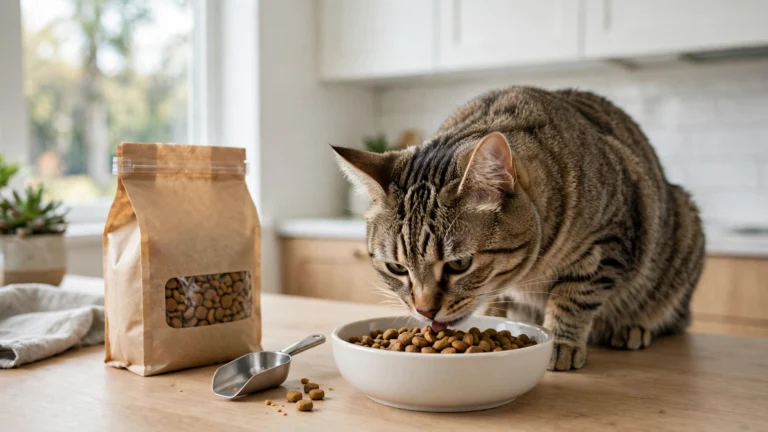
Dry food, often called kibble, is convenient, easy to store, and easy to measure. It has a long shelf life after opening when kept sealed and dry, and it suits owners who need a simple morning and evening routine.
Many cats like the crunch, and dry food works well in puzzle feeders that slow eating and add a little mental stimulation to mealtime.
The main drawback is water content. Dry food contains much less moisture than wet food, so a cat that eats only dry food must drink enough water from other sources.
Some cats drink well from a bowl, while others prefer fresh running water or multiple water stations around the home. If your cat rarely drinks, a mix of wet and dry food can be a practical way to add moisture without changing everything at once.
When you choose dry food, look for a complete and balanced statement for your cat’s life stage, a named animal protein near the start of the ingredient list, and a feeding guide on the pack as a starting point only. Avoid judging quality by the size of the bag, the picture on the front, or a single buzzword.
The label details in the section below matter more than the marketing claim.
Wet food: moisture and strong smell
Wet food comes in cans and pouches and contains much more water than dry food, which can help cats that do not drink much. It also tends to have a stronger smell, which can help fussy cats show interest in meals.
Wet food is often easier for older cats or cats with dental discomfort to eat, although dental health itself should still be checked by a veterinarian.
The trade offs are cost, storage, and waste. Wet food usually costs more per day than dry food, it must be refrigerated after opening, and leftovers should not sit out for long periods.
Portions also need care, because a full can may be more than one meal for a smaller cat. Serve fresh portions, cover and refrigerate the rest promptly, and discard food that has been left out too long.
Wet food is not automatically healthier than dry food, and dry food is not automatically worse. Both can be complete and balanced, and both can be poor choices if the formula is incomplete or portions are wrong.
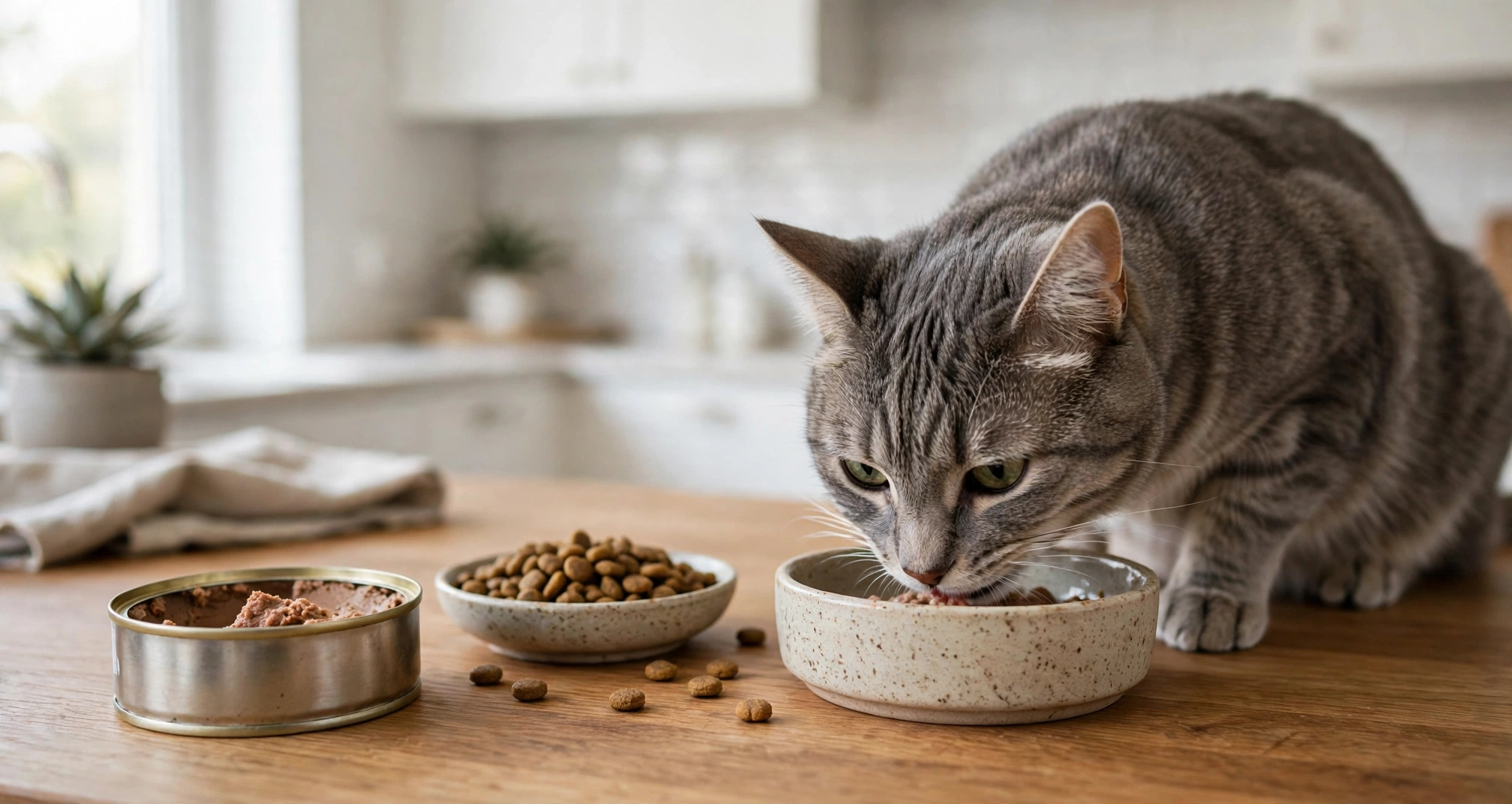
Many owners use a mix, for example dry food in the morning and wet food in the evening, which can balance cost, convenience, and moisture in a way that fits daily life.
Pate, chunks, and other wet textures
Pate is a smooth, soft wet food with no visible chunks, and it is a useful option for cats that prefer a uniform texture or that lick gravy and leave chunks behind. Chunks in gravy or jelly give a different mouthfeel, and some cats strongly prefer one texture over the other.
Texture preference is real, and it can look like fussiness when a cat simply dislikes a certain form.
If your cat refuses a new food, check texture before you assume the flavour or brand is the problem. Try the same broad type in pate form if chunks were rejected, or try chunks if pate was ignored.
Keep the rest of the routine steady, offer the food at normal meal times, and do not leave many different bowls out at once, which can make it harder to tell what the cat actually ate.
Texture also affects how you store and serve food. Pate can dry out at the edges once opened, so cover it well in the fridge and serve it at room temperature rather than straight from cold storage when possible.
Warming is not required, but very cold food can put some cats off, so a short time out of the fridge before serving can help.
Grain free food: what it does and does not mean
Grain free means the recipe does not use grains such as wheat, corn, or rice as ingredients. It does not mean carbohydrate free, because grain free recipes often use other carbohydrate sources such as potato, peas, or lentils.
It also does not mean higher protein by default, because the total recipe still depends on the full ingredient mix and the nutrient levels on the label.
Some cats do well on grain free food, and some do equally well on food that includes grains. True grain allergy in cats is uncommon, and digestive upset has many possible causes, including a sudden food change, too many treats, stress, or illness.
Do not assume grains are the cause of a problem without veterinary guidance, and do not assume grain free is safer or more natural simply because the label sounds simpler.
If you try grain free food, judge it the same way as any other food: complete and balanced statement, life stage match, steady stool, stable weight, good appetite, and no new vomiting or itching. If a problem appears or continues, stop guessing and talk to a veterinarian, who can help rule out health causes before you keep testing diets at home.
Limited ingredient food: simpler, not always better
Limited ingredient food uses a smaller number of main ingredients, often one main animal protein and one main carbohydrate source. The idea is to reduce exposure to ingredients that might be linked to sensitivity, and to make it easier to track what a cat is eating.
For some cats with a suspected food sensitivity, a simpler recipe can be a useful part of a veterinary guided trial.
Limited ingredient does not mean hypoallergenic, and it does not prove that other ingredients were the problem. A food can still be unsuitable if it is not complete and balanced, if portions are wrong, or if the sensitivity is not food related at all.
Avoid long elimination trials at home without veterinary input, because an incomplete trial can delay proper diagnosis and leave a cat on an unsuitable diet for too long.
When you read a limited ingredient label, check the same basics as any other food: life stage, complete and balanced statement, named protein source, and feeding guide. A short ingredient list is not a quality score on its own.
What matters is whether the full recipe meets your cat’s nutritional needs and whether your cat stays well on it over weeks, not just for a few meals.
Homemade food: only with proper guidance
Homemade cat food sounds appealing because you control every ingredient, but it is the easiest type to get wrong. Cats need specific nutrients in the right balance, including taurine and other nutrients that are easy to miss in a home recipe.
A diet made from plain meat alone, even good quality meat, is not a complete cat diet.
If you want to explore homemade feeding, do it only with veterinary or veterinary nutrition guidance, using a recipe that is formulated to be complete and balanced, not a recipe copied from a general website. Supplements, cooking method, portion size, and storage all matter, and small errors can build up over time.
For most owners, a good commercial complete food is simpler and safer than a homemade plan.
Homemade treats and toppers are different from a full homemade diet, but they still count toward the daily total. A small amount of plain cooked meat as an occasional treat is not the same as replacing meals with home cooking.
Keep treats small, avoid seasoned, raw, or unsafe foods, and ask your veterinarian if you are unsure whether a particular food is safe for cats.
Food type comparison table
| Food type | Pros | Cons | Best for |
|---|---|---|---|
| Dry food | Easy to measure and store, long shelf life, works well in puzzle feeders | Low moisture, easy to overfeed if the bowl is always full | Owners who want a simple routine and cats that drink well |
| Wet food | High moisture, strong smell, often appealing to fussy cats | Higher daily cost, needs refrigeration after opening, leftovers spoil faster | Cats that drink little, older cats, and cats that prefer soft food |
| Pate | Smooth texture, easy to eat, good for cats that leave chunks behind | Can dry out once opened, some cats prefer chunks or gravy | Cats that prefer a uniform soft texture |
| Grain free | Avoids grains, may suit cats that do well without them | Still contains carbohydrates, not automatically higher in protein or healthier | Cats whose veterinarian has agreed a grain free trial is sensible |
| Limited ingredient | Simpler recipe, easier to track ingredients | Not the same as hypoallergenic, still needs a complete and balanced formula | Cats on a veterinary guided diet trial for suspected sensitivity |
| Homemade in general terms | Full control over ingredients, no commercial additives if planned well | Very easy to make nutritionally incomplete without expert formulation | Owners working closely with a veterinarian or veterinary nutritionist |
Use the table as a starting point, not a final verdict. The best cat food for indoor cats is the complete food your cat eats willingly, digests well, and maintains weight on, within a routine you can keep up every day.
A perfect food on paper is not helpful if your cat refuses it, if it upsets digestion, or if it is too costly or awkward to serve consistently.
How to choose the best cat food for indoor cats: a practical checklist
Start with life stage, then look for a complete and balanced statement on the label. After that, check the named protein source, the overall nutrient profile, and whether the food fits your cat’s known needs, such as weight control or hairball support in general terms.
Price and availability matter too, because a food you cannot buy regularly will lead to repeated switches.
Next, think about your cat’s habits. Does your cat drink well, prefer wet or dry texture, eat fast, or leave food behind? Does your cat play actively, or rest most of the day? Answers to these questions point to moisture needs, texture, puzzle feeding, and portion size more reliably than a front of pack claim.
Daily play and enrichment also support healthy weight, and ideas in the cat behaviour and care guides can help you build activity into the day alongside measured meals.
Finally, give a new food a fair trial of several weeks once the transition is complete, unless a clear problem appears sooner. Judge by appetite, stool consistency, vomiting frequency, coat condition, energy, and weight trend, not by one meal.
Keep notes for a week or two if you are comparing foods, because memory alone can make a new food look better or worse than it really is. For a closer look at daily portions, see the companion guide How Much to Feed a Cat, noted in the metadata above, alongside the wider cat food and feeding guides.
How to read a label without getting lost
Start with the nutritional adequacy statement, which should say the food is complete and balanced for a life stage such as adult maintenance, growth, or all life stages. This statement matters more than words like premium, natural, or holistic, which are marketing terms and do not guarantee a complete recipe.
If the statement is missing or unclear, treat that as a warning sign.
Then look at the ingredient list in order, keeping in mind that ingredients are listed by weight before cooking, so fresh meat high on the list does not tell the whole story. A named source such as chicken, salmon, or lamb is clearer than a vague term such as meat meal without a named source, although named meals can also be useful concentrated protein sources.
Avoid judging a food by one ingredient alone, and check the guaranteed analysis for protein, fat, fibre, and moisture as a broad guide.
The feeding guide on the pack is a starting range based on weight, not a personal prescription. Use it to set an initial portion, then adjust based on body condition, activity, and veterinary advice.
The calorie content, when shown, helps you compare foods, because a more energy dense food needs a smaller portion than a less dense food to provide the same energy. If two foods look similar but one is much more energy dense, portion size must change, even if the bowl looks less full.
Feeding amounts in general terms
There is no single correct portion for all indoor cats, and this guide does not give a personal daily amount in grams or calories for your cat. Use the feeding guide on the food label as a starting point, then adjust with your veterinarian’s guidance based on your cat’s current weight, body condition, age, and activity level.
A cat that is gaining weight usually needs a smaller total daily amount or more play, while a cat that is losing weight needs veterinary review before you simply add more food.
Split the daily total into two or more measured meals where possible, rather than leaving food out all day. Measured meals make it easier to notice a change in appetite, which can be an early sign of illness.
Weigh food with a kitchen scale or a consistent measuring cup at first, until you know what the correct portion looks like, because eyeballing portions tends to drift upward over time.
Treats, toppers, and food used for training all count toward the daily total, so keep them small and reduce the main meal slightly on days when treats are higher. Fresh water should always be available, and water bowls should be cleaned and refilled daily.
If your cat eats very fast, a puzzle feeder or a slow feeder bowl can help, and spreading meals across the day can reduce begging between meals.
Watch body condition rather than the scale alone. You should be able to feel ribs with light pressure without pressing hard, and your cat should have a visible waist when viewed from above in most healthy adult cats, although body shape varies.
If you are unsure how to judge body condition, ask your veterinarian to show you at a routine visit, and use that check as your reference point at home.
How to transition foods safely
Switch foods slowly over about a week to ten days, unless your veterinarian advises a faster change for a medical reason. Start with a small amount of the new food mixed into the old food, then increase the new food share gradually while the old food share falls.
This slow change gives digestion time to adjust and makes it easier to spot a problem linked to the new food.
If stool becomes loose during the transition, slow down and hold the current mix for a few extra days before moving forward, provided your cat is otherwise well, eating, and drinking. If vomiting, refusal to eat, lethargy, or loose stool continues, stop the transition and seek veterinary advice rather than pushing through.
A food change should not be used to mask an ongoing health problem.
Keep the routine steady during the switch. Feed at the same times, use the same bowl and place, and avoid adding several new treats or toppers at the same time.
If you change too many things at once, you will not know which change caused a good or bad result. Once the new food is fully in place, give it time before judging, and keep the old food sealed for a few days in case you need to step back.
Cornell University College of Veterinary Medicine guidance on feeding cats stresses steady, complete nutrition, fresh water, and attention to changes in appetite or weight, which fits the approach in this guide. That kind of authoritative veterinary source is a better check than a single review or a social media claim, especially when a food promises a fast fix for weight, digestion, or hairballs.
Use expert guidance to frame the basics, then use your cat’s response and veterinary advice to fine tune the details.
Common mistakes to avoid
One common mistake is changing food every time a cat skips a meal. Cats can go off food for a short time for many reasons, including stress, heat, a new routine, or a minor upset, and frequent changes can make eating more unsettled.
Offer the normal food at normal times, remove uneaten wet food after a reasonable period, and seek veterinary advice if appetite loss lasts more than a day or comes with other signs of illness.
Another mistake is judging a food by the first bowl. A cat may eat a new food eagerly because it is novel, then lose interest, or may refuse it at first and accept it after a slow transition.
A third mistake is adding many supplements, oils, or toppers without guidance, which can unbalance an otherwise complete diet. Keep the base diet complete, keep extras small, and ask your veterinarian before adding a regular supplement.
Finally, avoid comparing your cat to another cat’s portion. Two cats of similar weight can need different amounts because of age, activity, metabolism, and health.
The feeding guide, body condition, and veterinary input together give a better answer than a neighbour’s bowl size or an online chart alone. Consistency, observation, and slow changes will serve most indoor cats better than constant searching for the best cat food for indoor cats.
What is the best cat food for indoor cats?
The best cat food for indoor cats is a complete and balanced food matched to your cat’s life stage, served in measured portions that keep weight steady. Wet food adds moisture, dry food adds convenience, and a mix often works well. Choose based on your cat’s appetite, digestion, drinking habits, and veterinary advice, not on a brand ranking or a single marketing claim.
Is wet food better than dry food for indoor cats?
Wet food is not automatically better, but its higher moisture can help cats that drink little water. Dry food can be equally complete and is easier to store and measure. Many indoor cats do well on a mix of wet and dry food, which balances moisture, cost, and convenience, provided total portions stay controlled.
Should I choose grain free food for an indoor cat?
Grain free food is a reasonable option, but it is not required for most indoor cats and it is not carbohydrate free. Grains are not harmful for most cats, and true grain allergy is uncommon. Choose grain free only if it suits your cat, is complete and balanced, and, where a health concern is involved, has been discussed with your veterinarian.
What is limited ingredient cat food, and who is it for?
Limited ingredient food uses fewer main ingredients to make tracking easier, often with one main protein source. It can be useful during a veterinary guided trial for a suspected food sensitivity. It is not automatically hypoallergenic, and it should still carry a complete and balanced statement for your cat’s life stage.
How much should I feed an indoor cat?
Feed the amount suggested on the food label as a starting point, then adjust with veterinary guidance based on weight, body condition, age, and activity. This guide does not give a personal gram or calorie amount, because individual needs vary. Split the daily total into measured meals, count treats toward the total, and review weight trends regularly.
How do I switch my cat to a new food safely?
Mix a small amount of the new food into the old food and increase the new share gradually over about a week to ten days. If stool loosens, slow down and hold the current mix for a few extra days. Stop and seek veterinary advice if vomiting, appetite loss, lethargy, or ongoing digestive upset appears during the change.
Does indoor cat food help with hairballs?
Some indoor formulas include extra fibre to support normal hair passage, and regular brushing can reduce loose hair. These steps may help with occasional hairballs in general terms. Frequent vomiting, retching, appetite loss, or changes in stool are not normal hairball signs, and they should be checked by a veterinarian rather than treated with a food change alone.